
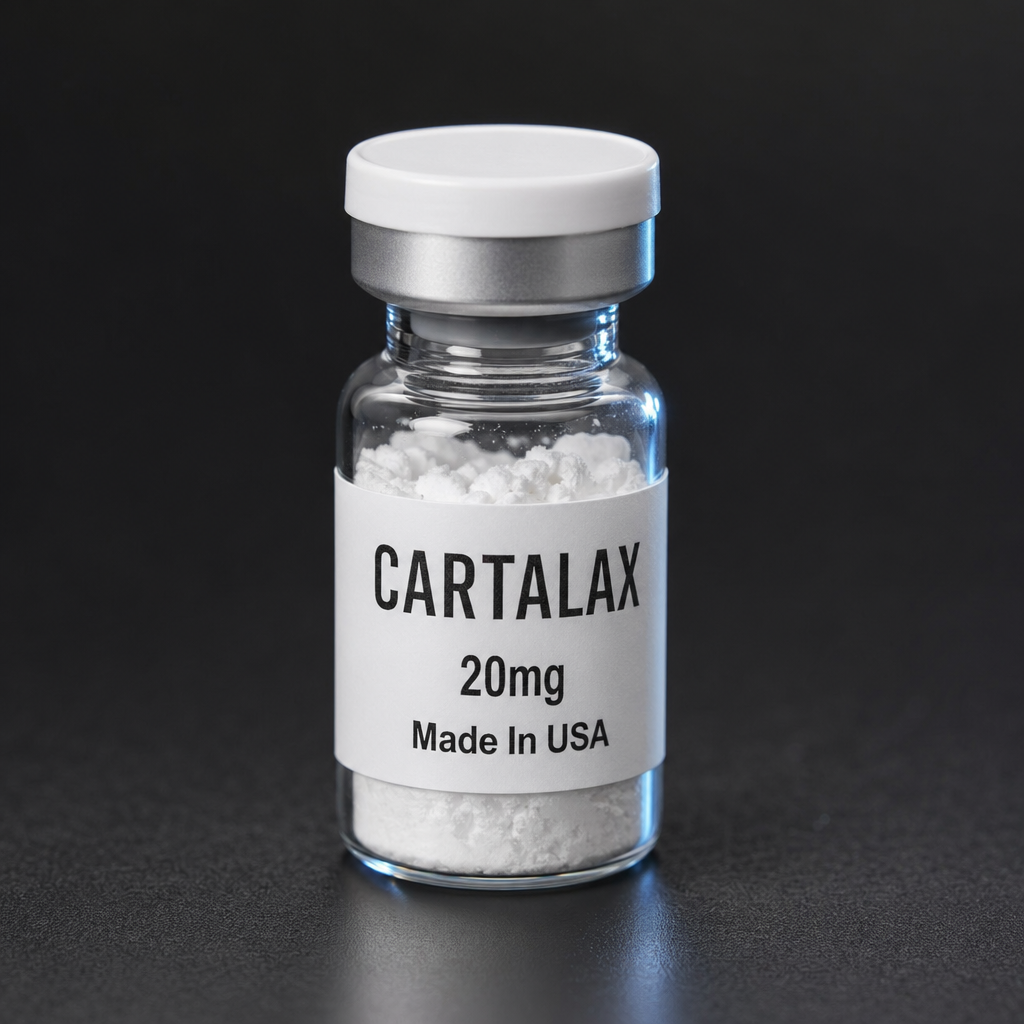
Cartalax (20mg)
Original price was: $79.00.$59.00Current price is: $59.00.
Description
Cartalax — also referenced in the literature as AED or T-31 — is a synthetic short peptide bioregulator developed within the Khavinson short-peptide framework at the St. Petersburg Institute of Bioregulation and Gerontology. Researchers comparing options for Cartalax typically work in fibroblast cultures, renal cell models, or biogerontology assays where short tissue-specific peptides have been studied for several decades. This page covers what the molecule is, what the published research reports, and what laboratories should look for when you buy Cartalax peptide for in-vitro work. Cartalax is supplied as a lyophilized powder for reconstitution and is strictly intended for preclinical research by qualified investigators. It is not approved for human or veterinary therapeutic use.
Cartalax Peptide Specifications
| Property | Value |
|---|---|
| Peptide name | Cartalax (also known as AED, T-31) |
| Sequence | Ala-Glu-Asp (AED) |
| Molecular formula | C12H19N3O8 |
| Molecular weight | 333.29 g/mol |
| PubChem CID | 87815447 |
| Purity | ≥99% by HPLC |
| Form | Lyophilized powder |
| Vial size | 20 mg |
| Storage | –20 °C lyophilized; 2–8 °C reconstituted |
| Reconstitution | Sterile bacteriostatic water or research-grade saline |
Cartalax Peptide
Cartalax is a synthetic tripeptide bioregulator originally characterized by researchers at the St. Petersburg Institute of Bioregulation and Gerontology, working within the bioregulatory peptide framework developed by Vladimir Khavinson and colleagues. It belongs to the broader class of cytogenic peptides — short oligopeptides that act as tissue-specific gene-regulatory signals at low concentrations.
Within the Khavinson peptide library, Cartalax sits alongside Epitalon, Vilon, Pinealon, Vesugen, and Bronchogen as one of the most extensively studied short peptides in the cellular aging and connective-tissue literature. Its name reflects early research positioning it for cartilage and articular tissue applications, though its documented activity extends across fibroblast and renal cell models as well.
Cartalax is highly water-soluble and well suited to in-vitro experimental models. The peptide is supplied as a 20 mg vial of lyophilized powder, reconstituted with sterile bacteriostatic water or research-grade saline immediately prior to use. Working concentrations described in the published literature generally fall in the low-microgram-per-milliliter range, with treatment cycles structured around defined exposure windows.
The Cartalax research timeline stretches from initial peptide isolation work in the 1970s and 1980s, through synthesis-based bioregulator programs in the 1990s and 2000s, into the molecular and cellular aging studies of the past two decades. This long arc of investigation has produced a substantial body of comparative data across the Khavinson short-peptide family, allowing researchers evaluating Cartalax to position their experiments within an established methodological framework rather than starting from scratch.
Chemical Makeup
Cartalax is a tripeptide composed of three L-amino-acid residues. Its sequence is Ala-Glu-Asp (AED in single-letter notation), corresponding to alanine, glutamic acid, and aspartic acid arranged in a defined N-to-C terminal order. The empirical molecular formula is C12H19N3O8, with a molecular weight of 333.29 g/mol and a PubChem identifier of CID 87815447.
The Khavinson short-peptide library spans dipeptides, tripeptides, and tetrapeptides — for example, Vilon (KE), Pinealon (EDR), Vesugen (KED), Cartalax (AED), and Epitalon (AEDG). Each is studied for tissue-specific bioregulatory effects within the same conceptual framework, and each shares the same general structural logic: a short, water-soluble L-amino-acid sequence designed to engage gene-regulatory pathways at low concentrations. Cartalax’s AED sequence is also notable as the N-terminal three-residue fragment of Epitalon (Ala-Glu-Asp-Gly), one of the most extensively studied Khavinson peptides in the cellular aging literature.
Cartalax is highly soluble in aqueous buffer. The lyophilized form is stable at –20 °C, with reconstituted solutions retained at 2–8 °C and used within the storage window defined by the supplier’s protocol. A Certificate of Analysis with HPLC purity verification at or above 99%, paired with mass-spectrometry confirmation of the AED sequence, is the standard documentation expected when purchasing Cartalax for laboratory use.
The three-residue length confers two practical advantages for research applications. Short peptides cross cell membranes and reach intracellular compartments more readily than longer chains, and they can be synthesized to high purity at reasonable cost. These properties have kept the Khavinson short-peptide framework a productive subject of investigation across more than four decades of published work.
Research and Clinical Studies
The published literature on Cartalax sits within a larger body of work on short peptide bioregulators originating from the St. Petersburg Institute of Bioregulation and Gerontology. Studies referencing Cartalax and closely related AED-family peptides have appeared in Bulletin of Experimental Biology and Medicine, Advances in Gerontology, Cell and Tissue Biology, Neuroendocrinology Letters, and several molecular biology and biogerontology journals. The translational work has not progressed to large-scale human clinical trials in Western regulatory frameworks, and Cartalax remains classified as a research-only compound in most jurisdictions.
Research involving Cartalax falls into three broad categories. The first is in-vitro work using primary cell cultures — fibroblasts, chondrocytes, and renal epithelial cells — measuring proliferation, extracellular matrix protein expression, and replicative lifespan. The second is molecular work on gene expression patterns, particularly genes governing collagen synthesis, matrix metalloproteinase regulation, and senescence-associated secretory phenotype markers. The third is preclinical work in aged rodents, evaluating connective-tissue integrity and indicators of biological age.
The molecular targets most frequently reported in Cartalax investigations include the collagen type I and type II genes (COL1A1, COL2A1), the cartilage proteoglycan aggrecan (ACAN), and the chondrogenic transcription factor SOX9. Studies have also examined regulators of extracellular matrix turnover including MMP-1, MMP-3, MMP-13, and the TIMP family of metalloproteinase inhibitors. Reported observations describe coordinated shifts across these target genes following Cartalax exposure — a pattern consistent with combinatorial gene-regulatory action rather than a single-pathway mechanism.
A practical consideration in study design is the choice of dose-response range. Published protocols generally describe testing a logarithmic concentration series — for example, 0.1, 1, 10, and 100 ng/mL — to identify the lower and upper boundaries of the bioregulatory effect within a given cell model. Short peptides in this class often produce measurable effects at very low concentrations and lose, or in some cases reverse, those effects at higher doses. Investigators new to peptide bioregulator work should consult the cited literature for cell-type-specific dosing references before finalizing a protocol.
Cartalax and Fibroblasts
Among the most-studied applications of Cartalax in the published literature is its effect on cultured human fibroblasts. Fibroblast cultures are a long-established model for cellular aging, extracellular matrix biology, and tissue regeneration, and the Khavinson group has reported a consistent set of observations across multiple short peptide bioregulators in these systems. Laboratories purchasing Cartalax for sale frequently begin work in fibroblast models for this reason — the assay infrastructure is well established and primary and immortalized lines are broadly available.
In studies referenced across Advances in Gerontology and Bulletin of Experimental Biology and Medicine, Cartalax extends the number of population doublings achieved by treated fibroblast cultures relative to untreated controls. Reported observations include alterations in expression of collagen type I and type III gene products and modulation of proteins involved in extracellular matrix remodeling. These findings have motivated comparative studies designed to map the dose-response curve in greater resolution and to evaluate whether the effects persist after withdrawal of peptide exposure.
A second group of fibroblast studies has examined the secretome of Cartalax-treated cultures, including changes in matrix metalloproteinase activity, tissue inhibitor of metalloproteinase (TIMP) expression, and downstream markers of cellular stress response. Researchers running Cartalax in fibroblast assays maintain matched control cultures for each passage condition, and many laboratories include a positive-control peptide from elsewhere in the Khavinson library — most commonly Vilon or Epitalon — to benchmark Cartalax against compounds with previously characterized effects in the same model.
Common fibroblast cell lines used in Cartalax investigations include the well-characterized human diploid lines WI-38, MRC-5, and IMR-90, as well as primary dermal fibroblasts isolated from age-stratified donor pools. The diploid lines provide standardized passage histories and a long history of comparative data; primary cultures allow investigators to capture donor-level variability that may interact with peptide exposure. Cross-laboratory comparison is most reliable when cell line, passage range, and serum conditions are matched to the prior literature.
Cartalax and Kidney Cells
A second well-represented area of Cartalax research involves renal cell cultures, including primary kidney epithelial cells and established renal cell lines. The interest in kidney models reflects the Khavinson framework — under which different short peptides act on specific tissues — and an experimental opportunity, since renal cells have been used to study aging, senescence, and inflammatory signaling in parallel with the connective-tissue work Cartalax is most closely associated with.
Published reports describe Cartalax effects on renal cell proliferation, viability under oxidative stress, and expression of genes associated with renal function and senescence. Several studies have measured whether Cartalax exposure modulates markers of inflammatory signaling within renal cell cultures, including expression of selected cytokines, NF-κB pathway markers, and stress-response proteins.
Specific endpoints measured in Cartalax renal work include 8-hydroxy-2′-deoxyguanosine (8-OHdG) as an oxidative DNA damage marker, the reduced-to-oxidized glutathione ratio (GSH/GSSG) as a redox-state indicator, and malondialdehyde (MDA) as a lipid peroxidation marker. Inflammatory readouts include interleukin-6, tumor necrosis factor alpha, and monocyte chemoattractant protein-1 (MCP-1), with NF-κB nuclear translocation assays providing a parallel measure of upstream pathway engagement. This multi-endpoint panel gives the dimensional view of renal cell response that comparative experimental designs in short peptide bioregulator research are built around.
Renal cell models cited in this work include HK-2 (human kidney proximal tubule), HEK-293 (human embryonic kidney), and primary tubular epithelial cells isolated from age-stratified donor tissue. HK-2 offers reproducible morphology and a well-characterized response to oxidative challenge; primary tubular cells preserve in-vivo phenotypic features that immortalized lines may lose over passage. Selecting the model that aligns with the published reference literature improves reproducibility and supports cleaner comparison across laboratories.
Cartalax and Cellular Aging
The third major category of Cartalax research, and the one with the deepest theoretical roots in the Khavinson framework, is cellular aging and biogerontology. The original research program from which Cartalax emerged was explicitly oriented around the question of whether short tissue-specific peptides could modulate cellular aging trajectories — a question that remains open in mainstream biogerontology and continues to attract new investigation across multiple laboratories worldwide.
Cartalax has been studied alongside related short peptide bioregulators in investigations of telomerase activity in treated cell cultures, expression of senescence-associated genes, accumulation of senescence-associated β-galactosidase staining, and morphological markers of replicative senescence in primary cell lines. Published reports describe delayed onset of senescence markers in Cartalax-exposed fibroblast and renal cell cultures, with the strongest experimental signal in cells that have undergone moderate prior passage and are approaching, but have not yet reached, the Hayflick limit.
A related line of inquiry covers the interaction between short peptides like Cartalax and the broader epigenetic landscape of aging cells, including DNA methylation patterns and histone modification profiles. While this work is at an earlier stage than the established fibroblast and renal studies, available reports point to gene-regulatory mechanisms by which short peptides may exert cumulative effects on cellular aging trajectories. Investigators sourcing Cartalax for aging studies typically structure experiments around defined passage windows, allowing rigorous comparison of senescence markers across treated and untreated cultures over the experimental timeline.
Telomere dynamics are another point of intersection between Cartalax research and the broader cellular aging literature. Short peptides in the Khavinson family have been examined for effects on telomere length maintenance and on the catalytic activity of the telomerase complex, including its TERT and TERC components. The reported observations are interpreted with appropriate caution given the complexity of telomere biology, but they continue to motivate cross-laboratory replication studies. Cartalax experiments at the intersection of senescence and telomere biology generally combine standard senescence staining with quantitative telomere length assays — for example, terminal restriction fragment analysis or quantitative PCR-based telomere length measurement — across a matched panel of treated and untreated culture conditions.
Sourcing Cartalax for Laboratory Use
Laboratories comparing options for Cartalax peptides should prioritize suppliers with full batch-level documentation: HPLC purity verification at or above 99%, mass-spectrometry confirmation of the AED sequence, lyophilization quality control, and a Certificate of Analysis with each shipment. Cold-chain handling and discreet domestic fulfillment are standard expectations among research groups conducting peptide bioregulator work at scale, and they are the baseline criteria for any purchasing decision intended to produce reproducible, publication-ready results.
Cartalax is supplied here as a 20 mg vial of lyophilized powder, independently verified for identity and purity, with a full Certificate of Analysis included with every batch and cold-chain shipping from a domestic facility. Strictly intended for in-vitro and preclinical research by qualified investigators. Not for human or veterinary therapeutic use, and not evaluated by the FDA.
References
- Khavinson VK. Peptides and ageing. Neuroendocrinology Letters. 2002;23(Suppl 3):11–144.
- Anisimov VN, Khavinson VK. Peptide bioregulation of aging: results and prospects. Biogerontology. 2010;11(2):139–149.
- Khavinson VK, Bondarev IE, Butyugov AA. Epithalon peptide induces telomerase activity and telomere elongation in human somatic cells. Bulletin of Experimental Biology and Medicine. 2003;135(6):590–592.
- Khavinson VK, Solov’ev AY, Tarnovskaya SI, Lin’kova NS. Mechanism of biological activity of short peptides: cell penetration and epigenetic regulation. Molecular Biology. 2013;47(3):332–339.
- Khavinson VK, Linkova NS, Kvetnoy IM, et al. Molecular cellular mechanisms of peptide regulation of synthesis of cytokines in cell cultures. Bulletin of Experimental Biology and Medicine. 2011;152(1):148–151.
- Lin’kova NS, Drobintseva AO, Orlova OA, et al. Peptide regulation of gene expression in cultured fibroblasts: a comparative analysis. Bulletin of Experimental Biology and Medicine. 2016;161(1):164–168.
- Khavinson VK, Malinin VV. Gerontological Aspects of Genome Peptide Regulation. Karger; 2005.
Reviewer & Disclaimer
Reviewed for technical accuracy by the supplier’s research team. Content is provided for informational purposes only and is intended for qualified researchers conducting in-vitro or preclinical work. Cartalax peptide products sold here are research-use-only and are not intended to diagnose, treat, cure, or prevent any disease. Statements have not been evaluated by the FDA.
Reviews
There are no reviews yet.